
Key takeaways:
-
Bigo CEO Mike Belshe proposes using a blockchain to stop billions in annual US fraud.
-
VP Vance’s focus on fraud schemes shows how this is affecting the U.S. economy.
-
Following 2025 trials, Russia enabled the digital ruble for all federal payments in January 2026.
Bitgo CEO Mike Belshe: Put Money on a Public Blockchain to Reduce Fraud
While the federal government is trying to stop what President Trump has called a “free-for-all theft” leading to state and federal fraud, cryptocurrency personalities have proposed new solutions to this issue.
Mike Belshe, CEO of Bigo, one of the leading custody providers for digital assets, proposed implementing a blockchain to curb this problem, which might account for losses reaching up to $521 billion annually.
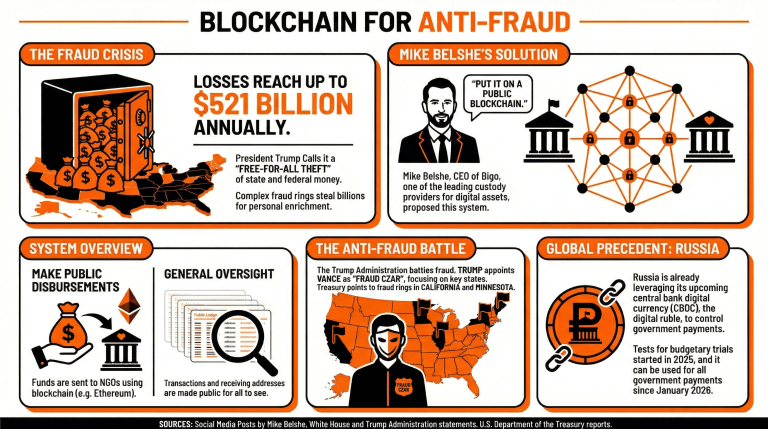
On social media, Belshe stated:
“There is a solution to all this state and federal fraud which doesn’t require repealing the money: put it on a public blockchain.”
The system would hypothetically include making public disbursements to non-governmental organizations (NGOs) using a blockchain like Ethereum, and then publishing the transactions and addresses receiving them for general oversight. “Citizens will take care of the rest,” he stressed.
Belshe’s remarks come at a time when the Trump Administration is publicly battling fraud, with Trump himself appointing Vice President Vance as “fraud czar,” focusing on states controlled by Democrats, including California, Illinois, Minnesota, Maine, and New York.
In California, eight individuals were recently arrested for their alleged involvement in a healthcare fraud scheme totaling over $50 million. The Department of the Treasury has stressed that “complex fraud rings in Minnesota have stolen billions of dollars from state programs for their personal enrichment in the United States and abroad.”
Russia has already tested its upcoming central bank digital currency ( CBDC), the digital ruble, for this same objective, with limited budgetary trials starting back in 2025. It can now be leveraged for all government payments since January 2026, with this use case identified as one “where the capabilities of the digital ruble can be used to best effect.”