
In Bitcoin ETF news today, US-listed spot BTC ETFs pulled in $853.54M in net inflows during the week ended August 7, the strongest weekly haul since mid-April, according to CoinGlass data. BlackRock’s IBIT alone accounted for roughly $693M of that total.
This means that around $0.81 of every dollar that entered the category came from BlackRock, signaling that the rebound looks less like broad institutional re-engagement and more like one fund doing most of the heavy lifting.
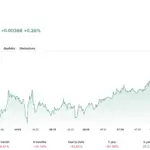
Bitcoin price pushed through $65,000 to touch $65,340 to start the week and finished up roughly 3%, even though four of the five ETF inflow days happened before that rally started.
$IBIT, $FBTC, $BITC, $ARKB, $MSBT have all seen inflows every single day (and growing each day) since the Coldcard Hack this wknd for a total of $620m. I'm not saying it's connected, we just don't know, altho long-term I can't imagine there aren't some who migrate over, but it's… pic.twitter.com/Y63ZUKsVJD
— Eric Balchunas (@EricBalchunas) August 6, 2026
Bitcoin ETF News: Five Days, $853M, and a Concentration Problem
Investors withdrew $8.26Bn from US spot Bitcoin ETFs over eight weeks through early July, highlighted by a $4.51Bn outflow in June, the worst month of the year, according to CoinGlass.
July’s recovery was minimal, with only $172.43M in inflows. However, August saw a turnaround with five consecutive positive sessions, totaling $1.03Bn from August 3 to 7, with the strongest inflow of $244.4M on August 5.
This follows a notable week in April when inflows reached $996.38M. Total net assets in spot Bitcoin ETFs now stand at $79.50Bn, roughly 6.10% of Bitcoin’s market cap.

Why the Money Moved: A Hack, a Jobs Report, and a Theory With Holes
Two key events coincide with the recent Bitcoin rebound. The first is the Coldcard exploit, which began on July 30 when attackers drained self-custody wallets with weakly generated seed phrases.
TRM Labs reported over $116M stolen from more than 5,200 addresses, while Galaxy Research estimates the total could be closer to $130M, marking it as one of the largest crypto thefts of 2026.
Eric Balchunas from Bloomberg Intelligence suggested that an ETF could be a solution, as ETF holders do not manage seed phrases directly, negating that risk entirely.
Supporting this view, long-term holders moved around 210,000 BTC following the exploit, with more coins being transferred to exchanges than leaving them, a reversal from a two-year trend.
The second event is the July jobs report released on August 7, which showed a decline in payrolls, making another Federal Reserve rate hike less likely.
Surprisingly, most inflows into Bitcoin, $754.69M of $853.54M, occurred before the jobs report, with the largest influx on Friday producing only $98.85M, just as Bitcoin saw its price rally.
Bitcoin ETF News: The Concentration Risk Nobody’s Pricing In
In other Bitcoin ETF news, two key figures challenge the Bitcoin-to-ETF narrative: IBIT accounted for 81% of the week’s inflows, while Ethereum ETFs gained $244.9M over the same period, according to CoinGlass.
If Coldcard-adjacent holders were increasingly moving from self-custody, we would expect more money to flow into Bitcoin ETFs, not Ethereum ones unrelated to a Bitcoin-only hardware wallet exploit.
Before the hack, Ethereum ETFs outperformed Bitcoin ETFs for three weeks, attracting $103.9M compared to Bitcoin’s $33.79M in the week of July 20.
The reversal in this trend after the exploit supports the custody theory, but it’s still circumstantial; there’s no evidence linking drained Coldcard wallets to specific ETF purchases, and QCP Capital noted limited concern in options markets.
With 81 cents of every new dollar going to a single fund, the category’s health hinges on that issuer’s interest and institutional investors’ decisions.
What Happens Next Decides Whether This Was Signal or Noise
If Bitcoin ETF news inflows keep outpacing Ethereum’s through late August, once the Coldcard hack is no longer fresh news, the custody argument holds up: investors genuinely re-rated self-custody risk and moved capital into regulated wrappers.
If Ethereum ETFs go back to out-raising Bitcoin ETFs the way they did for three weeks in July, the more likely explanation is that this was simply a strong macro week for risk assets that happened to follow a hack by coincidence.
Either reading needs more than five days of data to confirm. $853.54M recovers only about a tenth of the $8.26Bn that left the category over the prior eight weeks, and one good week doesn’t erase eight bad ones.
It’s worth remembering how differently this reads from periods when Wall Street’s Bitcoin ETF demand slowed to a near-standstill; the swing between those two states shows just how sensitive this market remains to a single narrative catching hold.
EXPLORE: Best Crypto Presales With Asymmetric Upside in the Current Market
The post Bitcoin ETF News: BlackRock Captured 81% of ETF Inflows in August Surge appeared first on 99Bitcoins.
Source: https://99bitcoins.com/news/bitcoin-btc/bitcoin-etf-news-blackrock-inflows/